
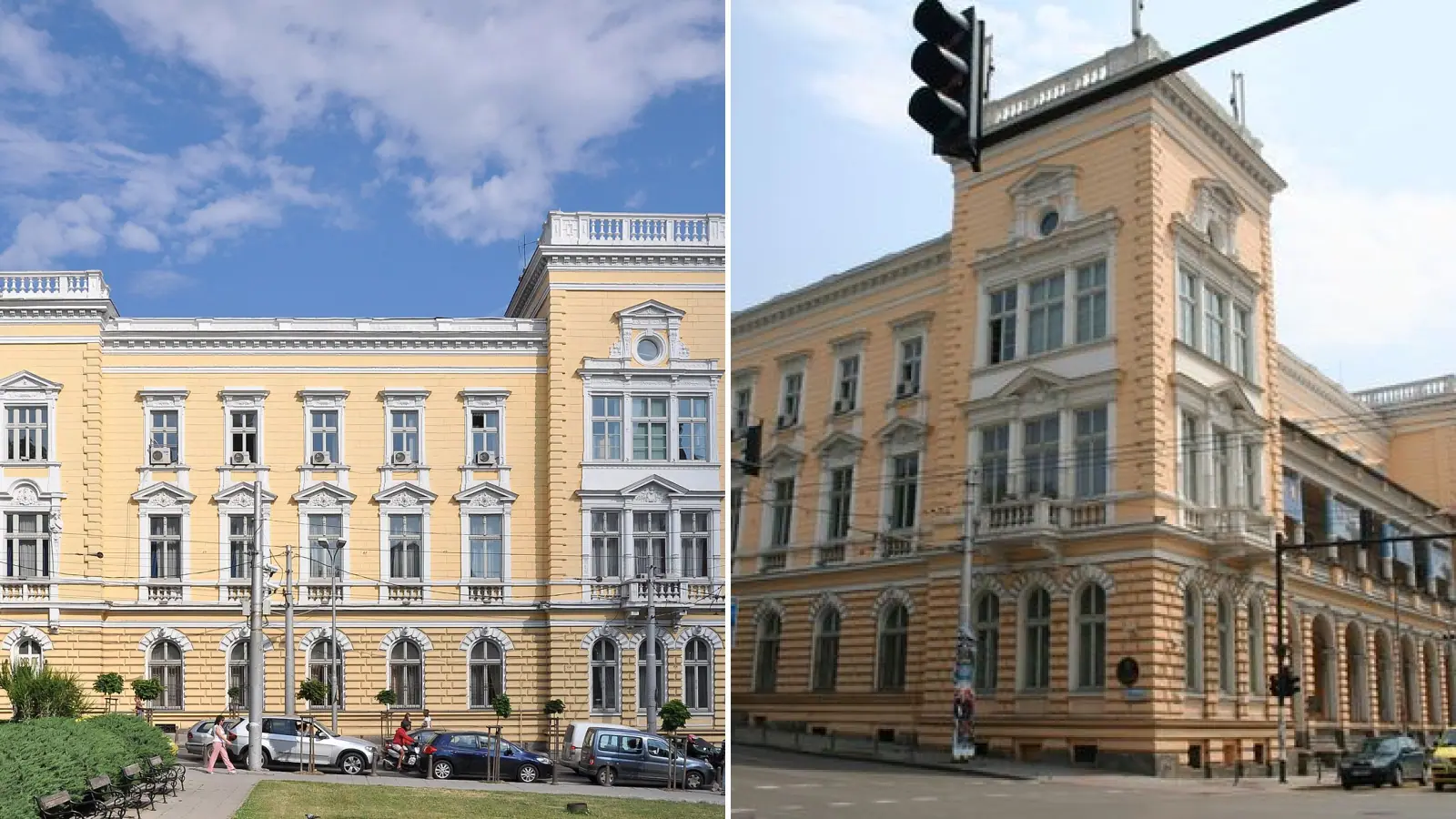
The Education Ministry presented the annual Pythagoras National Awards for contribution to science tonight at the Central Military Club, it said. The grand prize went to Prof. Ivaylo Tarnev of Aleksandrovska University Hospital and the Medical University of Sofia.
Prime minister Rumen Radev attended the event and handed over the award.
The previous development: Education ministry presents Pythagoras awards for 18th year in a row
Radev said funding for science infrastructure and research will rise from €35m this year to €62m in the 2027 budget. "This is not enough, but it is an important step, a clear sign from the state that we will keep backing all scientists," he said. He added that the government will also look for effective ways to work with scientists, not only through money but also in how the work is organised.
Education and science minister Prof. Georgi Valchev opened the ceremony. "People of science stay out of the spotlight, but they really do change the world," he said. In his view, society must do everything it can to bring their work into the light.
Prof. Tarnev's work is behind the first description anywhere in the world of 15 hereditary diseases. His research helps uncover the genetic causes of rare diseases and supports their early diagnosis and treatment. He has more than 400 scientific publications and is one of the main drivers behind the health mediator model in Bulgaria. He received a statuette and €8,000.
The contest is now in its 18th year. Awards are given in three fields: natural and engineering sciences, life sciences and medicine, and social sciences and humanities. Each honours established and young scientists, and there is also a special award for science communication. Winners in these categories received €5,000 each.
The award for an established scientist in natural and engineering sciences went to Prof. Petar Yordanov Antov of the University of Forestry in Sofia. He turns wood-processing waste into a valuable resource for new materials. His research focuses on sustainable wood materials made from renewable raw materials and industrial waste. His work offers new options for the wood-processing and furniture industries and helps make better use of resources and build a circular economy. Antov has more than 120 publications and more than 3,400 citations.
In life sciences and medicine, the award went to Prof. Slavcho Tomov, a corresponding member and director of the Research Institute at the Medical University of Pleven. He specialises in obstetrics, gynaecology and oncology, and develops robotic and minimally invasive surgery. On his initiative, Pleven has the country's first intraoperative laboratory for detecting metastases in lymph nodes in gynaecological cancers. Tomov is also among the leaders in building the Leonardo da Vinci Centre of Competence, which works in genomic medicine, 3D bioprinting and virtual reality.
In social sciences and humanities, the winner was Prof. Ivan Rusev of the University of Economics in Varna, a corresponding member. He studies the role of Bulgarian merchants and entrepreneurs in the National Revival and their links to the European economy. His work looks at how trade networks and enterprise helped modernise society in the 18th and 19th centuries. He initiated the Centre for Economic and Historical Research, where scientists from Bulgaria and abroad work.
Among young scientists in natural and engineering sciences, the award went to Dr Tsvetelina Kaneva, chief assistant professor at Angel Kanchev University of Ruse. She applies machine learning algorithms to big data from the energy and farming sectors. She builds models to forecast electricity production and use, to monitor solar power systems automatically, and to recognise animal behaviour from sensor data.
Among young scientists in life sciences and medicine, the winner was Assoc. Prof. Martin Karamanliev of the Medical University of Pleven. He is a cancer surgeon who works with robotic surgery and operations with remote mentoring. He was part of the teams that carried out Bulgaria's first robotic mastectomy and an international remote mentoring session during a robotic operation on a patient with rectal cancer. He studies fluorescence technologies in surgery and artificial intelligence in diagnosis.
Among young scientists in social sciences and humanities, the award went to Dr Mihaela Barokova, chief assistant professor at New Bulgarian University, who has a doctorate from Boston University. She works on language and communication development, mostly in children on the autism spectrum. She takes part in developing and adapting tools to assess communication, and in international studies of early child development. She pays special attention to Bulgarian children, because their language development is poorly represented in international literature.
The science communication award went to Prof. Radostina Alexandrova of the Institute of Experimental Morphology, Pathology and Anthropology with Museum at the Bulgarian Academy of Sciences. She explains biomedicine, viruses, vaccines, therapies and discoveries in plain language, and fights misinformation about health and vaccines. Alexandrova created "Minutes for Science with Radostina Alexandrova" and is the author of a podcast series on the history of medicine. She has made more than 800 media appearances and more than 150 popular science pieces.
All nominees received a certificate.





Comments (0)
No comments yet.